Industry AI/ML

AI-powered lead scoring system using hybrid heuristics and OpenAI embeddings to automate and prioritize high-fit leads at scale.
May 2025
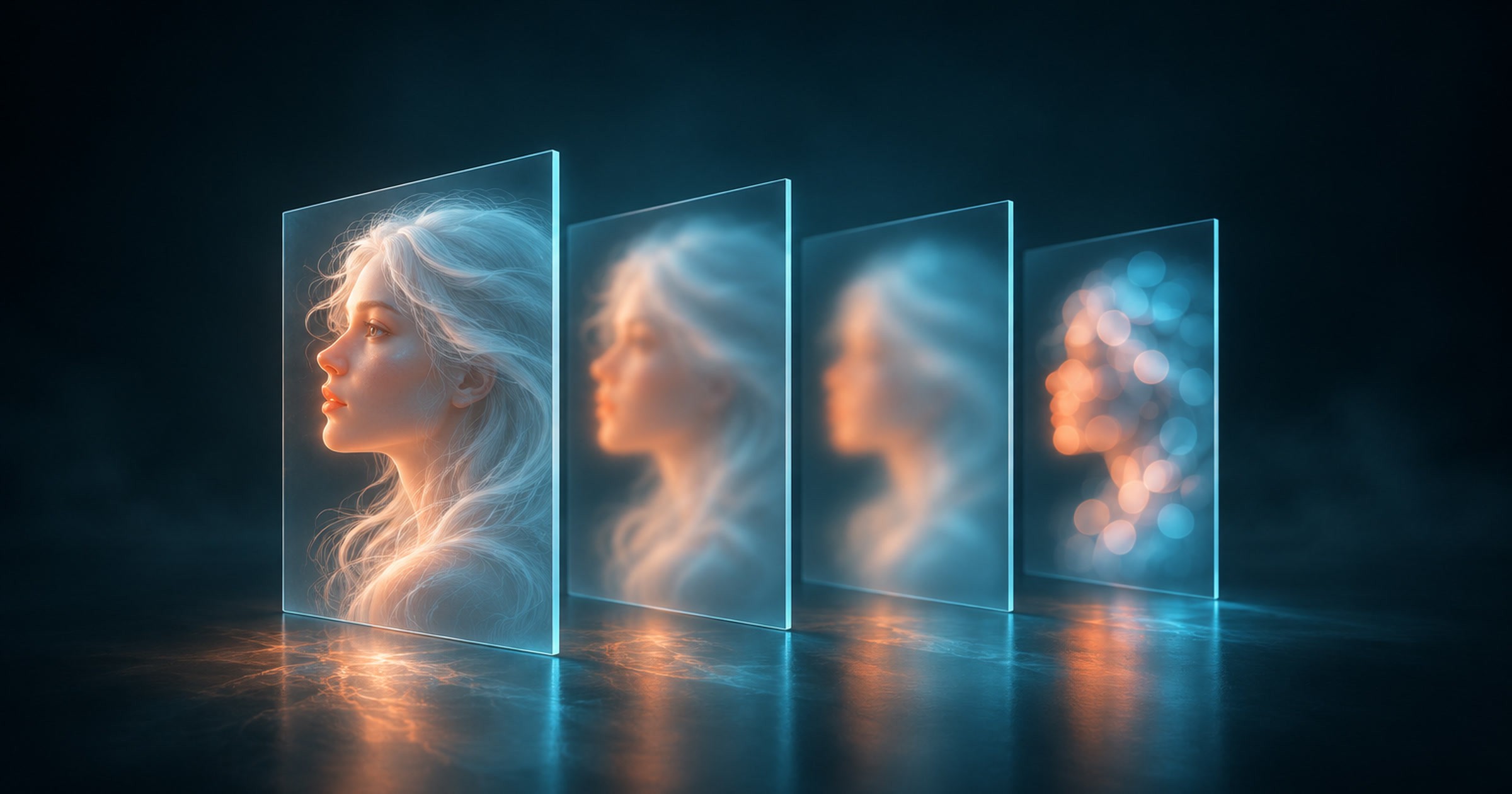
Synthetic video with exact depth, alpha masks, optical flow and bokeh for training depth-aware video bokeh models
Depth-aware video bokeh models learn from an all-in-focus video paired with a defocused version of it. Real pairs of sharp and defocused video are hard to capture, so every video bokeh dataset synthesizes the defocus.
Build a pipeline that composes training video from still-image layers, with exact disparity, alpha masks, optical flow and occlusion, and a bokeh renderer fast enough to run inside a training loop.
Prepared a library of 8,586 foregrounds and 20,000 backgrounds with estimated disparity, then composited sequences in which objects move in depth, and rendered their bokeh from the layers.
Released the library and a fixed set of 300 sequences. The renderer takes about 5 ms per frame at 1024 × 1024 pixels on one GPU, more than ten times faster than the other renderers that take layers.
Bokeh is the blur that a shallow depth of field gives a photograph, and it is hardest to render at depth discontinuities, where the blurred edge of a near object should partly reveal the background behind it. A single frame does not show that background, so a model that sees only the frame and its disparity makes errors there. To learn the effect, a video bokeh model trains on pairs of an all-in-focus video and a defocused version of the same video.
Published real pairs are still images taken at two apertures, and video pairs are hard to capture, so every video bokeh dataset synthesizes its defocus. LayerWise is a pipeline that composes such video from still-image layers, and a dataset made with it. Each sequence holds its all-in-focus frames, their disparity and a soft alpha mask for every object. On request it also holds exact optical flow, occlusion masks in both directions, and bokeh from a layered renderer. The work was done at Pompeu Fabra University for Huawei's depth-aware video bokeh research, and the code and the dataset are public.
A web demo generates a sequence from a seed and plays its streams side by side, in step, so a person can judge them against each other. A walkthrough is shown in Figure 1.
The inputs are still images only, and a depth estimator gives each of them a disparity map once, so every later sequence reads a ready library:
The library and the fixed set are on Hugging Face, 115 GB and 79 GB. Every sequence of the fixed set has 80 frames and 2.9 objects on average, and all but two of its 869 objects move in depth. The streams of one sequence are shown in Figure 2, and three more sequences at two time steps each in Figure 3.
The pipeline has two stages, shown in Figure 4:
Each object's alpha mask is soft, so a blurred edge mixes the object with what lies behind it, and amodal, so it includes the parts hidden by nearer objects. Stage B writes the sequences to disk, or runs inside a training loop's data loader, so a network receives sequences generated in memory. The depth estimator, the assets and the bokeh renderer can each be replaced.
The layered renderer was compared with four published ones on 120 sequences of 24 frames at 1024 × 1024 pixels, against a layered ray tracer that composites the layers in display values, as the pipeline does:
The bokeh strength is a setting of the renderer, and the same sequence at three strengths is shown in Figure 5.
LayerWise gives a depth-aware bokeh model exact supervision at object edges, where real data is hardest to get, and generates it cheaply enough to run inside a training loop. Its sequences are composed from flat layers rather than rendered from 3D scenes, so they have no camera parallax, shadows or refraction, and the disparity inside an object is estimated, not rendered.
The remaining limits are not fundamental: motion blur could be added along each layer's known motion, and the renderer can write the same scenes at other strengths. The data is for non-commercial research, as the licenses of its source images require.
AI-powered lead scoring system using hybrid heuristics and OpenAI embeddings to automate and prioritize high-fit leads at scale.
Time-series forecasting dashboard for monthly insurance claims and costs using SARIMAX seasonal models, scenario stress-testing, and AI-generated summaries.